Artist Automation
On making four thousand works with a machine, and keeping my hand.
1. The archive
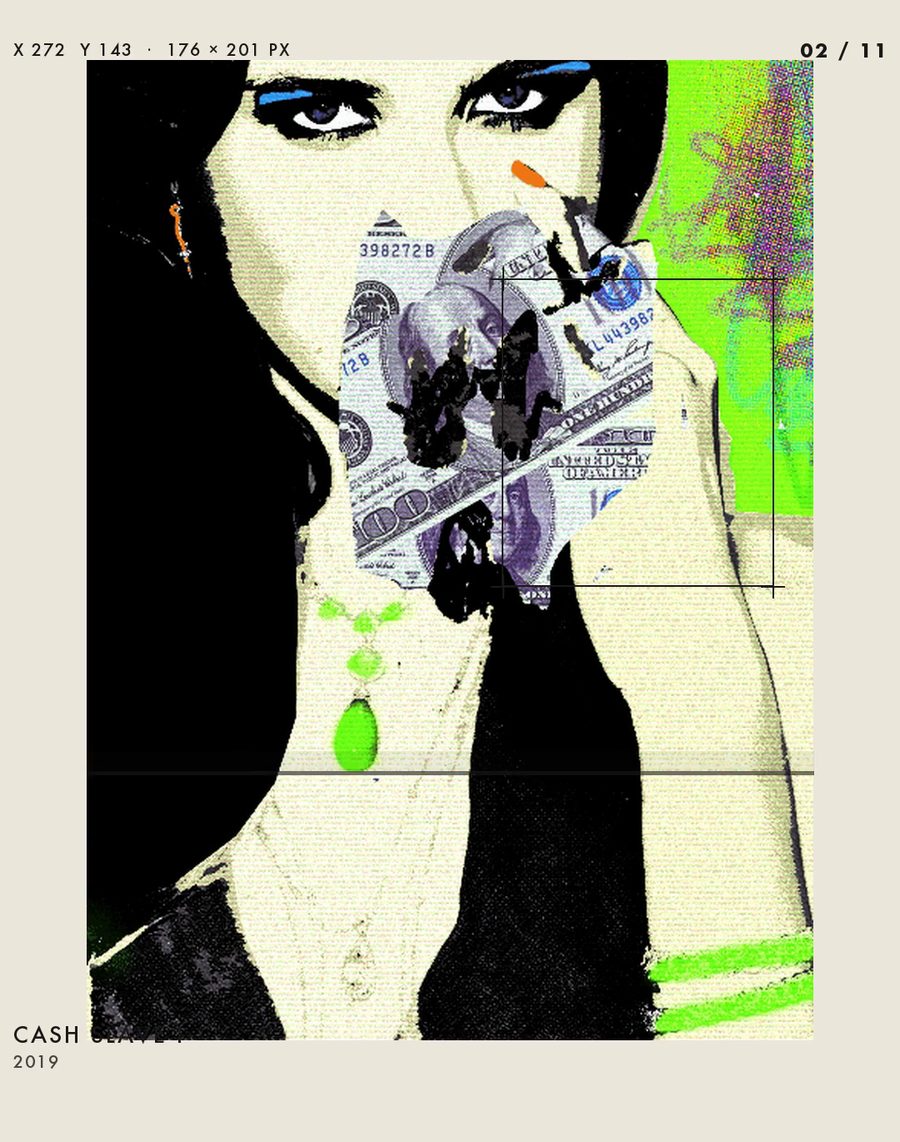
My archive begins in 2019. Bitcoin Bitch, Cash Slave, Old Money Corrupts, Drone Blondes, Interface, Soulbrds, Digital Graffiti, Diamond Drones, the Algorithmic Muse. Seven years of it: thousands of works, most of them minted, all of them mine.
For an artist that is not a back catalogue. It is material.
This year I wrote a machine to take it apart.
2. The machine
What it does is plain. It reads the archive. It selects a piece of one work, cuts it, and lays it on a sheet with pieces of others, according to rules I wrote: how many pieces, from how many works, from how many years. Never the same fragment twice across the collection. Never three of the same body in one work. The figure larger. Paper torn across the eyes.
It adds two things that did not exist before: a figure, and a collage ground, generated on models trained on nothing but my own drawings and my own sheets. It scores what it has made. If a face has crept in where I said no face should be, it throws the work away. Then it writes down everything it did.
It is called the Archive Engine. It proposed more than four thousand works. I kept four thousand.
3. What automation is not
It is not a new thing in the studio. Warhol said he wanted to be a machine and had assistants pull the screens. LeWitt wrote the instructions and other hands drew the walls: “the idea becomes a machine that makes the art.” Vera Molnár drew with an imaginary machine before she was allowed a real one. Harold Cohen spent forty years teaching a program to draw. Burroughs cut up the page. Höch cut up the magazines. The cut is old, the rule is old, the delegated hand is old.
What the word has come to mean lately is something else: a model trained on everyone’s pictures, prompted by anyone, owned by no one. That is not what this is. Nothing in these four thousand works was not, first, mine. Every fragment is traceable to a work with my name on it, a series, a year. The two models that make the new material learned from my hand alone.
The machine has no taste. It has rules, and the rules are mine.
4. Where the hand is
I did not touch a single cut. I touched every rule.
When the first proofs came back I changed them. More men in black tie. Paper across the eyes. No bikinis. More tulle, more feathers, hats, birds, animals. A collage ground with no model’s face in it at all. I looked at every work, and I refused some.
The machine proposed. I disposed. That is the division of labour, and it is an old one. What is new is that I can say exactly where the line falls, because the machine wrote it down.
This is a loop, not a mind. The machine is not in the work. There is no intelligence in the picture and I make no claim that there is. There is a hand, a rule, and a feedback between them, and you can check it, because the record is public.
5. The record
If a machine cuts four thousand times, the only honest thing is to write down every cut.
Every PAPER TRAIL work carries a RUTHVEN Origin Passport, recorded at the moment it was made: which pieces, from which works, from which years, in what order they were laid down; what was generated and what was cut; all of it fingerprinted and anchored on IPFS, where I cannot quietly change it later.
The collage is a paper trail. So is the record. The title is the same words twice, on purpose.
Most generative art asks you to trust the artist about the process. I would rather you did not have to.
6. What I am automating
Not the art. The art is the rules and the refusals, and those took me seven years to earn and a fortnight to write.
What I automated is the labour of remembering: which piece came from where, which year, which hand. That labour has always been done badly, by artists most of all, and it is why provenance is a mess. The machine does it perfectly, four thousand times, without getting bored.
Artist automation, then, is not the artist replaced. It is the artist with an archive that does not run out, because the material is her own past, and a record that does not forget.
The image forgets. The record remembers.
PAPER TRAIL · 4,000 works · each with a RUTHVEN Origin Passport · ruthven.ai/origin/paper-trail
Read next: The RUTHVEN Origin Passport, on why every work carries one.