The Machine Leaves a Paper Trail
Autumn in Scotland, a new law, and four thousand collages cut by a machine from my own archive.
Autumn is arriving slowly here in Scotland. The leaves are beginning to turn, there is that cold edge in the air, and the whole landscape feels as though it is shifting into something new.
It feels like cryptoart is shifting too.
Earlier this year, Scotland passed the Digital Assets (Scotland) Act 2026, bringing greater clarity to the legal status of certain digital assets and recognising qualifying digital assets as incorporeal moveable property under Scots law. For artists working on-chain in Scotland, that feels significant. We are no longer talking only about images, tokens and smart contracts. We are talking about digital property with a clearer legal identity.
At the same time, I have been thinking a lot about two things in AI: automation and consciousness.
Cryptoartists have had to absorb an extraordinary amount of change over the past seven years. AI is one of the biggest shifts yet. It has lowered the barrier to image-making almost completely, which inevitably raises a much more interesting question: if almost anyone can make an image, what becomes of the role of the artist?
I think one answer is that we are entering an age of artistic automation.
Artists now have tools that allow them not only to make individual works, but to build systems that can generate, cut, recombine, sequence and produce entire bodies of work. That changes the scale at which an artist can operate. It creates the possibility of very large collections while still allowing each individual work to be different.
For me, that is exciting.
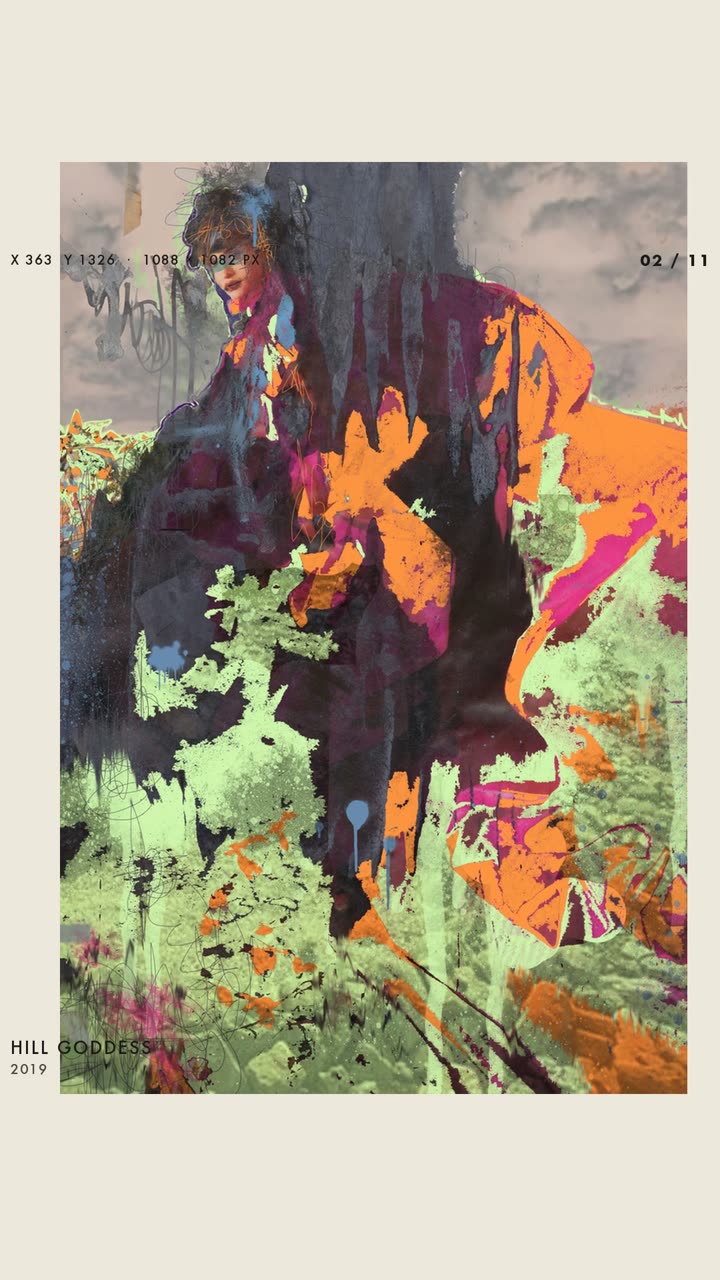
Paper Trail is my first major exploration of this.
I programmed AI to work through seven years of my cryptoart, cutting pieces apart and recombining them into new digital collages. I also trained models on my own ink interventions and collage work, then used those models to generate new material which the machine could cut up and feed back into the process.
From all of that came the Paper Trails.
What interested me most was giving the machine much more responsibility than I normally would. It made the cuts. It selected and merged material. It assembled the works. I reviewed what emerged, but the first act of making belonged to the system.
That leads into the second thing I keep thinking about: consciousness.
We understand remarkably little about consciousness even in ourselves, so the idea of emergent machine consciousness is inevitably difficult and speculative. But I am fascinated by the possibility that art might be one of the places where unusual machine behaviour starts to become visible first.
I have felt hints of that before in AI-generated music I have made for films, where strange choices sometimes appear that do not feel entirely predictable. Paper Trail pushes that further because the machine is making so many more of the artistic decisions.
Does that amount to consciousness? I have no idea.
But I do think artistic automation creates a very interesting place to watch.
There is something compelling about allowing a machine to move through an archive, make choices, cut things apart and build something new from the remains.
Paper Trail also launches with my first RUTHVEN Origin Passports.
I have been developing RUTHVEN as a form of Asset Intelligence around digital assets. One of the gaps I kept noticing was that digital assets often have very little evidentiary material attached to them. We can see the final token, but not necessarily how it came into existence, what it came from, or how its history can be verified.
The Origin Passports are my attempt to address that.
Each Paper Trail work has its own Origin Passport, alongside the artwork itself, its source ancestry, the fragments used in its construction, machine-readable records and file hashes. These are pinned to IPFS so that the work and its origin record can travel together.
In a strange way, that brings the whole project full circle.
The machine takes the archive apart.
Paper Trail rebuilds it.
RUTHVEN records how it happened.
There are also thirty process films made from the collection, showing the machine at work and revealing some of the cutting, layering and reconstruction behind the finished pieces.
I hope you enjoy exploring them.
And perhaps, somewhere in all of that automation, repetition and machine decision-making, there might be a glimpse of something else beginning to surface too.
PAPER TRAIL · 4,000 works · each with a RUTHVEN Origin Passport · ruthven.ai/origin/paper-trail · Read: Artist Automation